Outdoor Flat-Top Fry-Up
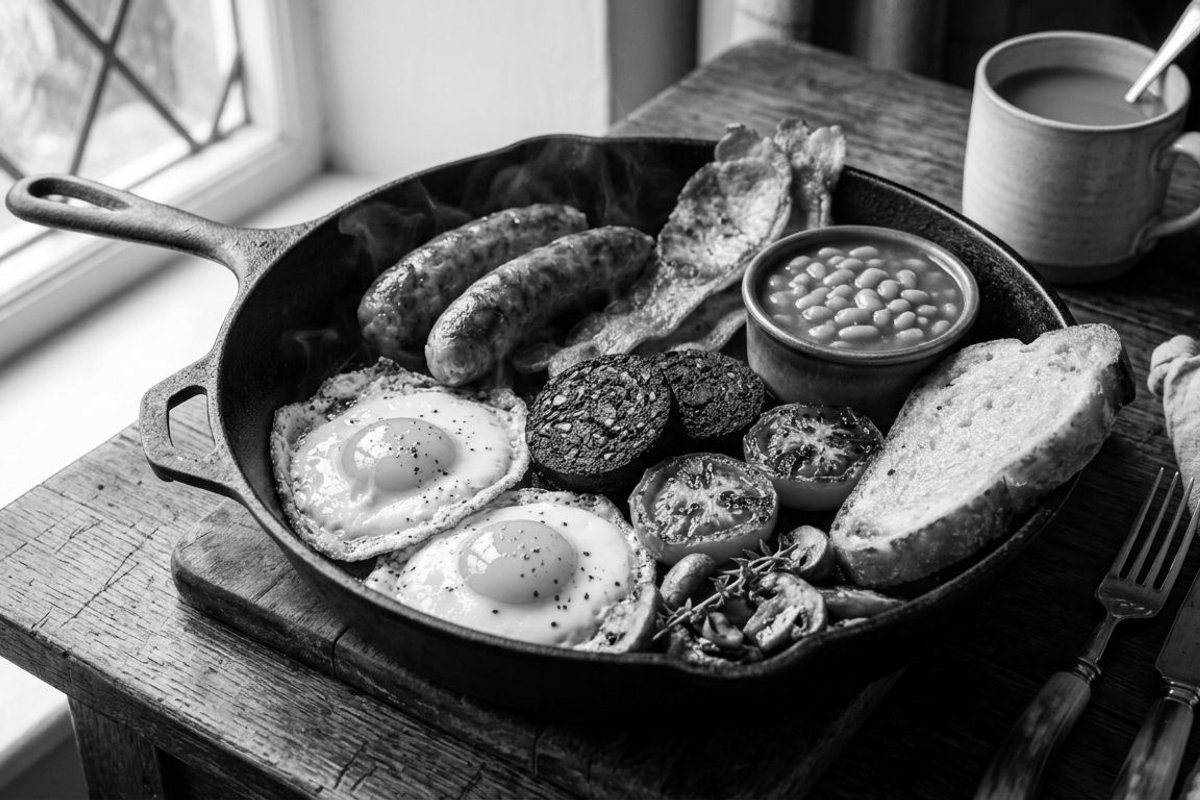
Doneness & Quality Checkpoints
- Zones mapped before food: water-drop test at three depths of the plate.
- Hot zone: 12–14-minute sausages rotated to the flame; hash browns turned once.
- Mid zone: bacon flat, pudding crusted, mushrooms face-down browned.
- Rim: tomatoes jammy, beans lazy-bubbling, eggs lace-edged and eight-simultaneous.
Outdoor Flat-Top Fry-Up
Prep: 15 minutes · Cook: 30 minutes · Total: 45 minutes · Serves 4
Ingredients
For 4 plates
- 8 pork sausages (640 g), pricked once
- 8 rashers (400 g) back bacon
- 8 thick slices (400 g) black pudding
- 8 large eggs (440 g)
- 400 g baked beans
- 4 frozen or par-frozen hash browns (360 g), or 600 g potato wedges, par-boiled
- 4 medium tomatoes (500 g), halved
- 300 g chestnut mushrooms, halved if large
- 8 slices (400 g) thick bread
Fat and seasoning
- 30 ml / 28 g neutral oil, for the plate
- 40 g butter
- 4 g fine sea salt
- 2 g black pepper
- 1 tsp (2 g) brown sugar, for the tomatoes
- Brown sauce and ketchup; a flask of tea or the billy on the corner
Instructions
- **Hot zone — sausages and hash browns, 12–14 minutes.** Lay the sausages in the plate's hottest centre zone with the hash browns beside them. Turn the sausages every 3 minutes, rotating their positions like carousel horses so each takes its turn over the hottest spot; turn the hash browns at 7 minutes. Checkpoint — sausages browned all around with taut skins and clear juices; hash browns deep gold both faces. The hot zone's test: the first sausage laid down sizzles loudly within 5 seconds — if it whispers, wait; the zone is not ready.
- **Mid zone — bacon and black pudding, plus mushrooms, 8 minutes.** At the sausages' halfway mark, lay the bacon in the mid zone, pressed flat for 10 seconds each. Three minutes later, the black pudding slices join, then the mushrooms in the remaining mid-ground, cut-faces down. Checkpoint — bacon flat and glassy-amber; pudding crusted and holding; mushrooms browned faces-down, glossed. The zones are working when each component cooks at its own pace on the same plate — nothing burnt at the centre, nothing steaming at the rim.
- **Cool rim — tomatoes, beans, and the bread, 6 minutes.** The tomato halves go cut-face up at the rim with sugar and salt; the beans in a shallow pan or folded foil tray set at the plate's very edge, warming through; the bread toasts where the plate meets the air — its last heat, 60–90 seconds a side with a smear of butter. Checkpoint — tomatoes slumped jammy; beans bubbling lazily; bread golden with butter-freckles. The rim's cooking is gentle by design — the components there want warming and blistering, not searing.
- **The eggs across the mid zone, 3 minutes.** Clear the mid zone's cooked components to the warming plates. A fresh film of oil plus half the butter down, and the 8 eggs cracked straight onto the steel in two rows. Flat-top eggs are the crispy-edged master's method: 90 seconds undisturbed for lace, then a half-turn toward the cooler side for the last 30 seconds if the zone runs fierce. Checkpoint — lace-fringed whites, set and glossy, yolks liquid — eight at once, the flat-top's signature sight and the reason the method exists.
- **The pass — four plates at the same minute.** Off the plate in reverse order: eggs lifted last onto each plate's crown, then the works arranged around — sausage, bacon, pudding, hash brown, tomato, mushrooms, beans at the side, bread propped. Sauce bottles down the table's middle; tea poured. Checkpoint — four complete plates, all hot, all landed inside the same minute — the flat-top's entire justification. At a pan, the fourth plate waits; at a flat-top, the family sits. The plate scrapes clean with the fish slice and a splash of water while still hot — the steel's cleaning is its re-seasoning.
Finish & Plate
Family style down the table, sauce bottles centred, and the flat-top's theatre as the meal's opening act — everyone watching their breakfast cook is the oldest form of dinner-party entertainment. The plate cools, wipes, and re-oils for the next batch; a second round for late risers is 15 minutes' work on a seasoned surface.
Troubleshooting
| Symptom | Cause | Fix |
|---|---|---|
| Everything cooked at one speed | No zoning — heat even everywhere | Rake coals to one end; map with the water-drop before the food lands |
| Food stuck to the steel | Plate under-seasoned or not hot enough | The smoking-oil wipe; the 5-second sizzle test per zone |
| Burnt middles, raw rims | Zones inverted — delicate food at the flame | Eggs, beans, tomatoes always at the rim; only sturdy foods over the centre |
| Second batch cooked unevenly | Steel un-scraped, heat unmapped again | Scrape and re-oil while hot; re-map — the zone map shifts as coals settle |
Storage, Make-Ahead & Variations
- **Cooked components hold and reheat** on the warm plate's rim or a tray at 160 °C; eggs always cook fresh to order — the flat-top's whole point is that fresh is easy. - **Variation — the burger-van breakfast roll:** the flat-top's eggs and bacon in a floury bap with brown sauce, cooked at the cool rim for the queue — the method's most famous commercial form, reproduced exactly. - **Variation — the Plancha deluxe:** add 8 quail eggs at the rim for the mini-full-English plates' companion dish — 90 seconds each, the flat-top's most charming trick. - **The kit note:** any steel plate over any controllable heat runs this recipe — a dedicated flat-top, a cast-iron griddle, a plough disc. The zones are the recipe; the steel is just where they live.