One-Pan Cast-Iron Fry-Up
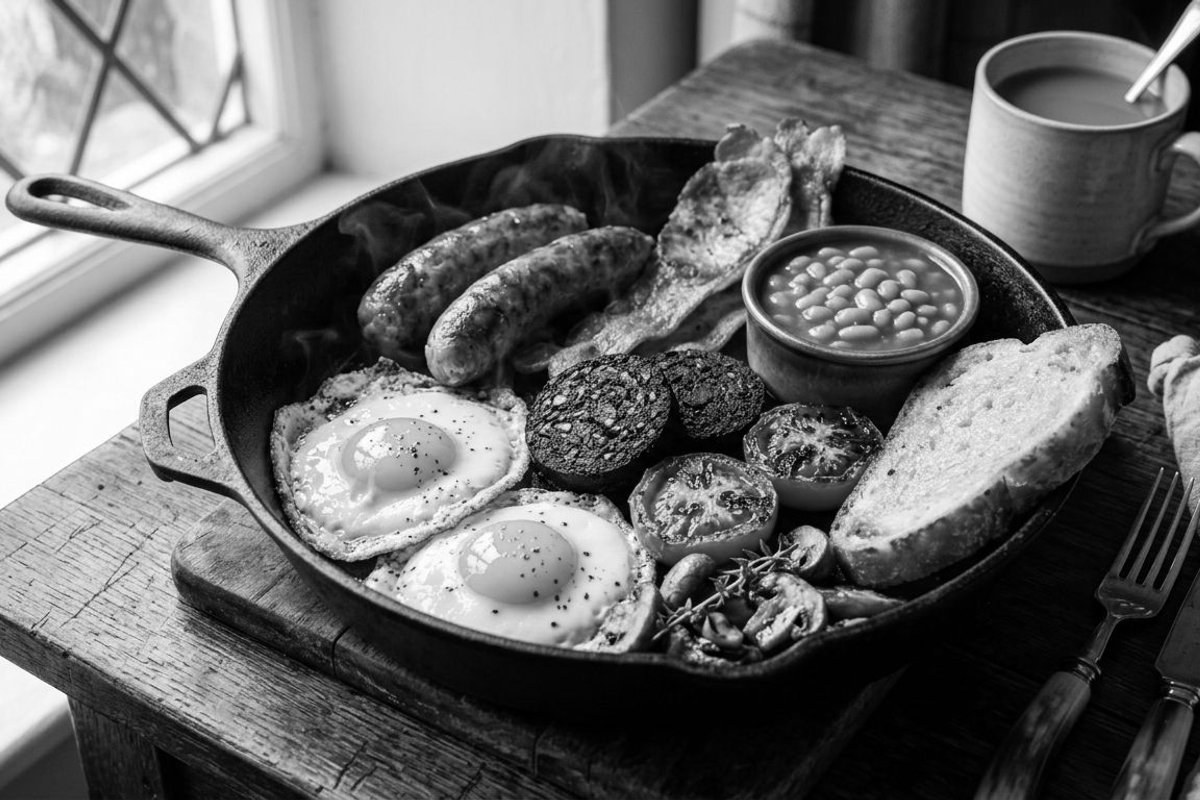
Quantities live in the recipe card.
The meats
The vegetables
The potato
The eggs and bread
Fat and seasoning
Doneness & Quality Checkpoints
- Sequence discipline: sausage → bacon → pudding/potato → mushroom/tomato → eggs, no stage washed away.
- Fat ledger: a thin slick throughout, never dry, never pooling; topped up or poured off as needed.
- Eggs: set whites, running yolks, lace edges, layered pan flavour.
- The pan: wiped, not washed — the economy compounds into the next cook.
One-Pan Cast-Iron Fry-Up
Prep: 10 minutes · Cook: 30 minutes · Total: 40 minutes · Serves 2
Ingredients
The meats
- 2 pork sausages (160 g), pricked once each
- 3 rashers (150 g) smoked back bacon, halved crosswise
- 3 thick slices (150 g) black pudding
The vegetables
- 150 g chestnut mushrooms, halved
- 1 large vine tomato (150 g), halved through the equator
The potato
- 200 g cold boiled potatoes, thickly sliced (or 1 par-frozen homemade hash brown)
The eggs and bread
- 3 large eggs (165 g)
- 2 slices (100 g) thick white bread
Fat and seasoning
- 5 ml / 5 g neutral oil, just to start the sausages
- 2 g fine sea salt
- 1 g black pepper
- 1 tsp (2 g) brown sugar, for the tomato
- Brown breakfast sauce, to serve
Instructions
- **Sausages — 12 minutes, the pan's foundation.** Film the cold pan with the oil and set over medium-low heat. Lay in the sausages and cook 12 minutes, turning every 3–4 minutes, until browned on all faces. The low start renders their fat slowly — it becomes the pan's cooking medium for everything after. Checkpoint — the sausages are evenly deep-gold with taut, unsplit skins (one pin-prick venting), and the pan holds a visible slick of rendered fat, about a tablespoon, with a fine lace of brown fond across the base where they touched. The sausage stage has seasoned the pan.
- **Bacon — 5 minutes.** Slide the sausages to the pan's edge, lay the bacon halves in the hot centre, and cook 3–4 minutes until the fat renders glassy, then flip for 1–2 minutes more. Pull the bacon when the fat is crisp-edged and the eye is just set and rosy. Checkpoint — the bacon lies flat (the cast iron's even heat keeps it from curling), the rendered layer in the pan has deepened to amber, and the fond at the edges has darkened one shade further.
- **Black pudding and potatoes — 6 minutes.** Add the black pudding slices and the potato slices to the pan's centre, turning the potatoes in the accumulated fat. Cook 3 minutes a side — the pudding crusted dark and firm, the potatoes golden and crisp-edged, drinking the pan's seasoning. Checkpoint — the potato slices have a golden, lightly crusted face and hot fluffy middle; the black pudding holds its shape with a dark crust and no crumbling. The pan's fat now carries three layers of flavour.
- **Mushrooms and tomato — 6 minutes, the pan's peak.** Push the pudding and potatoes to the edge and add the mushrooms cut-face down in the pan's centre, then the tomato halves cut-face up with their sugar and salt. Cook the mushrooms undisturbed 3 minutes to brown their faces, then toss; the tomato roasts in place, cut-face never touching the pan, until it slumps. Checkpoint — the mushrooms are browned and glossy; the tomato has collapsed by a quarter, its cavity bubbling with jammy reduced juice; the pan smells layered — sausage, bacon, browned butter-fat, all one perfume now.
- **The eggs — 3 final minutes, the pan's dividend.** Clear the pan's centre (everything cooked now rests at the edges, keeping warm over the pan's lingering heat, or on the warm plates if space is tight). Check the fat: you want 2–3 mm; top up from the reserved bowl or a knob of butter if short. Raise the heat to medium, crack in the eggs, and fry-baste 2–3 minutes — spooning the pan's layered fat over the whites until they set and the edges go lace-gold, yolks liquid. Checkpoint — the whites are fully set with crisp lacy fringes, the yolks still run, and — the one-pan fry-up's signature — the eggs taste faintly, gloriously of everything that came before them: sausage, bacon, mushroom, in one bite.
- **Wipe, never wash — the pan's future.** Plate everything: the eggs at the crown, the meats and potato arranged clockwise, mushrooms and tomato filling the gaps, bread fried for 1 minute in the pan's last of the fat if there's any to spare. Then, when the pan has cooled: pour off remaining fat, wipe with a paper towel, and put it away. The seasoning this breakfast built becomes the next breakfast's head start. Checkpoint — the plate is a complete fry-up born of one pan; the pan, wiped and cooling, holds a patina worth protecting.
Finish & Plate
Two plates from the one pan, the eggs landing last and crowning the plate. This is the version to cook for someone you want to impress without appearing to try: bring the pan itself to the table on a wooden board, a trivet under it, and serve from the pan café-style. Brown sauce on the side, tea in the mug, and the kitchen to wash up consisting of exactly one pan and two plates.
Troubleshooting
| Symptom | Cause | Fix |
|---|---|---|
| Fond turned black and bitter by stage 3 | Heat too high, or stages rushed | Medium-low for sausage and bacon; if it darkens fast, pour off fat, wipe lightly with a dry towel, continue |
| Later components stuck hard | Pan seasoning thin or pan not preheated | Preheat 2 minutes before the sausages; a patina builds with every cook — persist |
| Everything overcooked by the egg stage | No rest space at the pan's edge | 26 cm minimum; rest cooked items on warm plates in a 100 °C oven |
| Eggs greasy rather than laced | Fat pooled too deep | Pour off to 2–3 mm before the eggs |
| Pan smoked the kitchen out | Rapeseed or olive oil past its smoke point in a hot cast iron | Start with 5 ml neutral oil only; the meats supply the rest |
Storage, Make-Ahead & Variations
- **Make-ahead:** the components reheat well (10 minutes at 180 °C), but the one-pan experience is a now dish — its point is the sequence and the dividend egg. Leftovers keep 3 days. - **Variation — one-pan bubble finish:** fold the last stage's eggs over a thin layer of bubble-and-squeak pressed into the pan instead of plain — the eggs baste the bubble's crust as it forms. - **Variation — the camping version:** the identical sequence over a single camp burner or fire grate, the pan's discipline even more valuable when heat is uneven. Long-handled cast iron is the kit. - **The pan's ledger:** regulars of this method report the pan's eggs improving for months — the strata of seasoning are cumulative. Never soap, never soak, always wipe.