Homemade Cumberland Sausage Ring
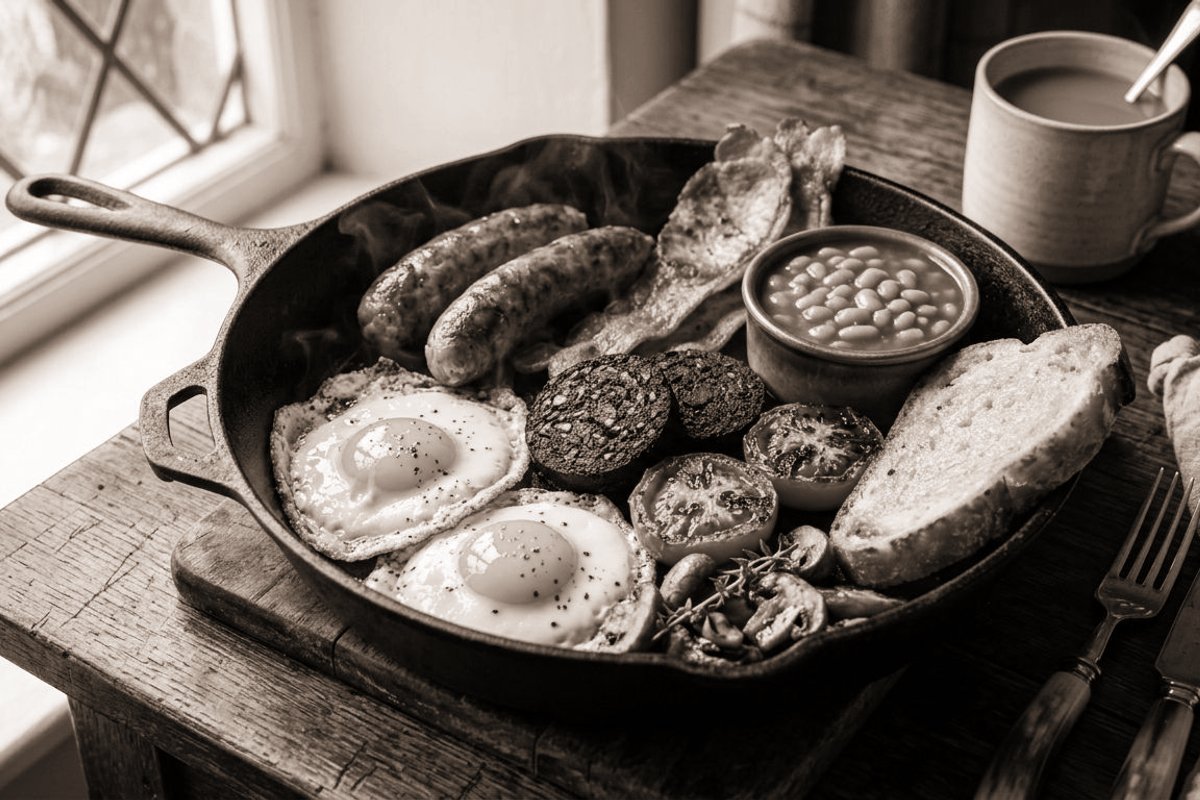
Quantities live in the recipe card.
The meat
The seasoning — Cumberland's plain-bold signature
- the visible, biting flecks are the county's trademark)
The binder
- a drier, meatier mix)
The casing
Doneness & Quality Checkpoints
- Chop coarse — coarsest of the family; cracked (not ground) pepper visible in the mix.
- Test-fry tasted pepper-forward; binder kept drier than the Lincolnshire's.
- Stuffed as one even rope, air pricked out; coiled compact with ends tucked.
- Rested overnight; cooked whole at medium-low to 71 °C at the thickest ring.
Homemade Cumberland Sausage Ring
Prep: 30 minutes, plus overnight rest · Cook: 25 minutes · Total: Overnight plus 1 hour · Makes 1 ring (about 500 g)
Ingredients
The meat
- 700 g pork shoulder, cut into 2 cm chunks, partially frozen
- 200 g pork belly or fatty pork, cut into 2 cm chunks, partially frozen
The seasoning — Cumberland's plain-bold signature
- 8 g fine sea salt
- 5 g coarsely cracked black pepper (cracked, not ground — the visible, biting flecks are the county's trademark)
- 1 g ground white pepper
- 1 g ground mace
- 0.5 g ground nutmeg
- No herbs. None. This is the recipe's line in the sand.
The binder
- 40 g rusk or fine dry breadcrumbs (less than the Lincolnshire — a drier, meatier mix)
- 70 ml cold water
The casing
- 1 length natural hog casing (about 1.5 metres), soaked and flushed
- A pinch of flour, for the tray
Instructions
- **Chop coarse.** Pulse the chilled pork in two batches to distinct 3–4 mm flecks — coarse gravel, never paste — and combine in the chilled bowl. Checkpoint — visible meat grain, matte and separate. The Cumberland is the coarsest of the county sausages; when in doubt, pulse less.
- **Season, bind, test-fry.** Scatter the salt, both peppers, mace, and nutmeg over the meat; toss. Sprinkle the rusk, add the water gradually while working by hand 1–2 minutes to sticky cohesion. Fry the test patty 3 minutes and taste. Checkpoint — the patty reads pepper-forward — a genuine, building warmth — with the pork's sweetness under it and no herb in sight. The pepper should be the first and the last thing you notice; if it whispers, add a gram. The test-fry is the recipe's only opportunity to correct it.
- **Stuff as one rope.** Fit the casing onto the nozzle and feed the mixture through steadily, guiding with two fingers, filling the casing evenly — plump with a little give, never taut — into a single long rope. Do not twist links; the rope is the product. Checkpoint — an even, plump rope with consistent diameter along its length, no bulges or air pockets (prick any air bubbles with a pin and press gently). The casing should feel like a full sausage at every point, with the same finger-pressure give throughout.
- **Coil the ring.** On the floured tray, coil the rope into a flat spiral, starting from the outside and working in, tucking both ends beneath the coil. The spiral should sit compact and self-supporting — about 18–20 cm across — with each ring just touching, not compressed. Checkpoint — a neat, flat spiral that holds its shape on the tray, ends hidden beneath, no ring pinched thin. The coil's geometry is the presentation; a slack, wandering rope is a link sausage that lost its nerve.
- **Overnight rest, uncovered, in the fridge** — 12–24 hours for the seasoning to marry and the casing to dry. Then cook whole, as the Cumberland fry-up directs: medium-low, 8 minutes a side, two spatulas for the turn, probed to 71 °C at the thickest ring. Checkpoint — the cooked ring is deeply browned on both faces, holds its spiral at the lift, and cuts into clean wedges showing the coarse, pepper-flecked interior. The ends, once tucked, have sealed themselves into the coil.
Finish & Plate
Cooked in the Cumberland sausage fry-up's sequence, cut into wedges at the pan, and served with the eggs that cooked in its peppered fat — the ring's whole performance. The raw ring also freezes (2 months, tray-frozen then bagged) and the mix, unstuffed, is the pepper-forward sausage meat for rolls and the full-English pie.
Troubleshooting
| Symptom | Cause | Fix |
|---|---|---|
| The rope smeared into paste | Warm meat or over-pulsing | The 45-minute freeze; fewer pulses — rescue is a 15-minute re-chill |
| Ring burst its casing in the pan | Overstuffed taut or heat too high | Fill with give; medium-low and the fry-up master's patience |
| The coil fell apart on the turn | Ends untucked or rings not touching | Both ends beneath; a compact spiral that supports itself |
| Pepper lost in cooking | Ground pepper used, or shy measure | Cracked flakes and the full 5 g — the test-fry is the check |
Storage, Make-Ahead & Variations
- **The raw ring keeps 3 days refrigerated** and freezes 2 months; cooked wedges keep 3 days and reheat in 8 minutes at 180 °C. - **Variation — the breakfast ring:** the coil wound around a centre of whole peeled hard-boiled eggs (3, spaced), baked 35 minutes at 180 °C — the sausage-and-egg ring, a Sunday centrepiece and a picnic classic. - **Variation — the devilled coil:** the pepper doubled to 10 g and a pinch of cayenne — the northern chip-shop's aggressive cousin. - **The family table:** Lincolnshire (sage), Cumberland (pepper), and sage-and-onion (both worlds) — three homemade sausage records, one coarse-chop technique, and a household that never buys a banger again.