Camping Fry-Up
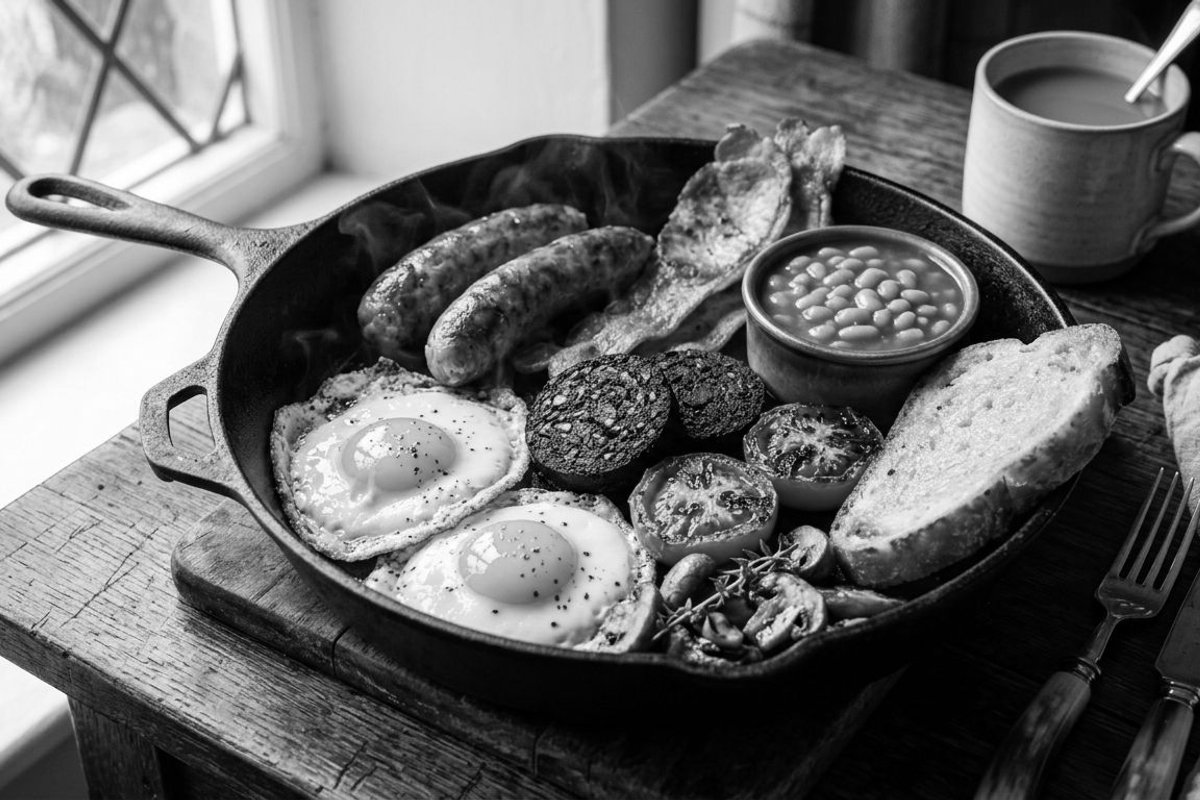
Doneness & Quality Checkpoints
- Sausages: 12 minutes, pan-shifted, foil-lidded finish; clear juices.
- Bacon flat; mushrooms browned (the windbreak's proof); beans thickened.
- Eggs: lid-steamed whites, liquid yolks — the camp baste.
- Everything served from the pan, hot, fast, before the air wins.
Camping Fry-Up
Prep: 10 minutes · Cook: 30 minutes · Total: 40 minutes · Serves 2
Ingredients
The plate
- 4 pork sausages (320 g), pricked once
- 4 rashers (200 g) back bacon
- 4 large eggs (220 g)
- 200 g baked beans (half a tin — the tin is the camp pot)
- 2 slices (140 g) thick bread
- 1 tomato (150 g), halved
- 100 g mushrooms, halved if large
Kit and fat
- 1 heavy cast-iron or carbon-steel pan, 26 cm, with a lid or a double layer of foil
- 20 g butter, 15 ml / 14 g oil
- 3 g salt, 1 g pepper
- Brown sauce sachets or a small bottle
- Tongs, a fish slice, and a mug that doubles as a measuring cup
Instructions
- **Sausages over medium — 12 minutes, pan-shifted.** Prick the sausages once each. Over a medium flame, cook them 12 minutes, turning every 3, shifting the pan half off the burner whenever the spitting turns violent. A foil lid over the pan's half for the last 4 minutes helps the centres cook through on a crude flame. Checkpoint — browned all over, taut-skinned, clear juices at a nick, and the pan holding its first slick of fat — the fry's currency, exactly as the kitchen version runs.
- **Bacon, then mushrooms and tomato — 8 minutes.** Bacon in the fat, pressed flat, 2–3 minutes a side to glassy-amber; lift to a warm plate (the pan's lid, inverted, is the camp plate-warmer). Mushrooms and tomato into the remaining fat for the last 5 minutes. Checkpoint — bacon flat and amber; mushrooms browned, not steamed; the tomato blistered and soft — the windbreak and the medium flame earning their keep, because a guttering flame grey-stews mushrooms where a steady one browns them.
- **Beans in the pan's corner, bread on the flame — 5 minutes.** Push everything to the pan's edges, tip the beans into the hot centre, and warm them 4–5 minutes until bubbling and slightly thickened. Meanwhile the bread toasts on the grill rack above or fries in a corner of fat for 45 seconds a side. Checkpoint — beans bubbling thick (camp beans want a shade thicker than kitchen beans — they cool faster in the open air); bread golden, holding its structure.
- **The eggs, lidded — 3 minutes.** Clear the pan's centre, add the butter, crack in the eggs when it foams, and — the camp method — lid the pan and lift it half off the flame. The lid's trapped steam sets the whites from above while the pan's base fries them from below: a basted egg without the basting, built for a flame that will not hold a steady medium. Checkpoint — whites fully set, tops filmed not raw, yolks still liquid — the lid's steam has done the spoon's work. Pull the pan fully off the heat the moment the whites lose their shine; carryover finishes them.
- **Plate on the board, mugs poured.** The whole pan to the table — a board on the grass, a bench at the fire — and serve from it: sausages, bacon, mushrooms, tomato around the pan's edge, beans ladled, eggs lifted last, bread for the yolk. Sauce sachets opened with the teeth, tea from the billy. Checkpoint — the eating test, outdoors: every component at outdoor temperature — which cools faster than any kitchen, so eat with intent — and the plate tastes exactly like the café's, plus woodsmoke and weather. The pan wipes with a paper towel and goes back in the crate; the fat economy's ledger closes for the morning.
Finish & Plate
From the pan, on the board, with the mugs and the morning. The camping fry-up's honest ranking: it is not a lesser version of the café plate but the original one — the dish before the caff existed — and every kitchen technique on this site descends from a pan like this over a flame like that.
Troubleshooting
| Symptom | Cause | Fix |
|---|---|---|
| One side burnt, one raw | Flame uneven, pan parked dead centre | Rotate the pan a quarter-turn every few minutes; park components by the gradient |
| Everything cooled instantly | No windbreak, plates cold | Windbreak up; serve from the hot pan, not onto cold plates |
| Eggs rubbery | Full flame under the lid | Lid plus half-off-the-flame; pull at the shine-loss |
| Beans scorched at the base | Crude flame at full under a thin corner | Keep the beans moving; pan-shift every minute |
Storage, Make-Ahead & Variations
- **No refrigeration storage beyond the day** — the camp larder is the cool box and the appetite. Sausages and bacon travel from home frozen; they thaw to ready by the second morning. - **Variation — the fire-grate version:** the same sequence over embers, not flame — embers' even heat is the finest stove the dish has ever had, and the pan-shift becomes almost unnecessary. Cook to the coals' colour, not the clock. - **Variation — the one-pot version:** skip the separate eggs; crack them into wells in the beans for the last 3 minutes, lidded — the hash's camping cousin. - **The kit note:** the pan is the recipe's only real equipment demand — cast iron, 26 cm, with a handle that survives the fire. Everything else is what the kitchen version uses, packed smaller.