Breakfast Scotch Eggs
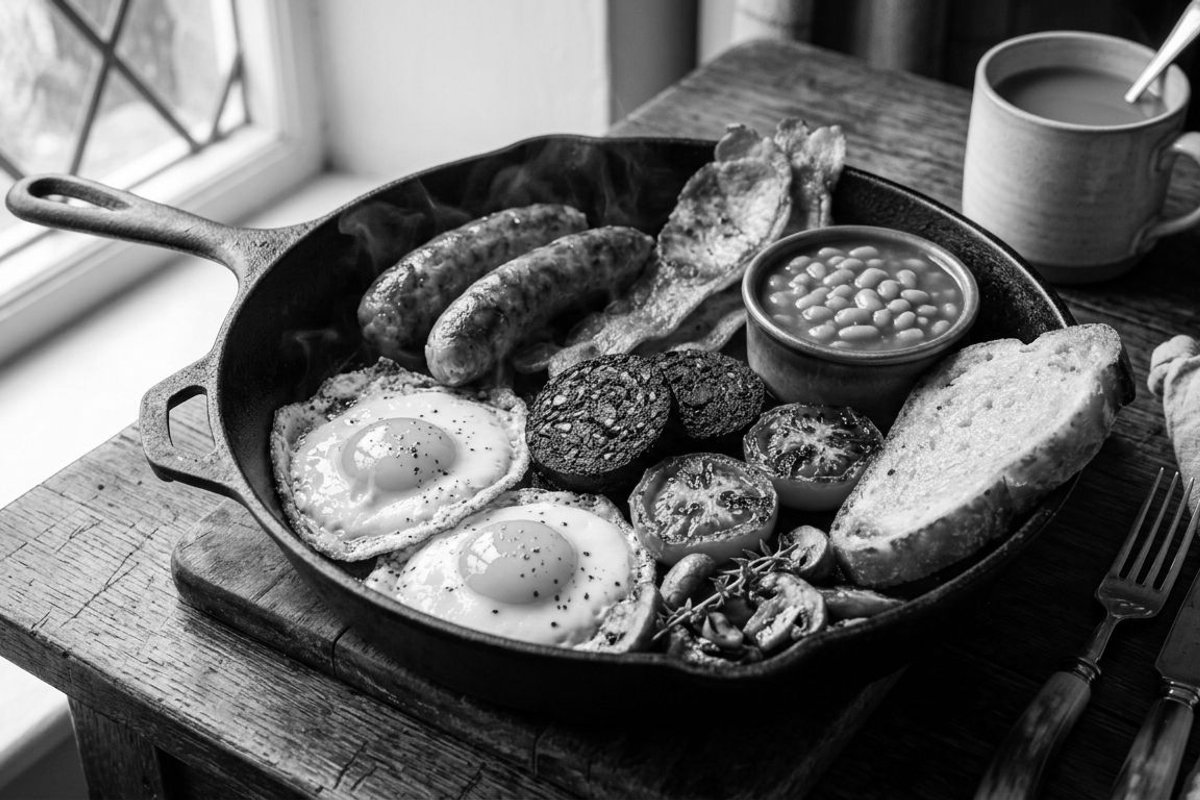
Quantities live in the recipe card.
The eggs
The sausage layer
- a coarse Cumberland or Lincolnshire is ideal
- ready sausages are already seasoned)
The coating
To fry
Doneness & Quality Checkpoints
- Eggs: 6½ minutes, ice-bathed, jammy yolk; peeled without yolk tears.
- Sausage layer: even 1 cm, no thin patches, chilled before and after breading.
- Fry: 170 °C, 5–6 minutes to deep gold; sausage layer at 72 °C+.
- Rest: 4 minutes on a rack; cut reveals flowing-jammy yolk.
Breakfast Scotch Eggs
Prep: 30 minutes, plus 30 minutes chilling · Cook: 20 minutes · Total: About 1 hour 20 minutes · Makes 6 Scotch eggs
Ingredients
The eggs
- 6 large eggs (55 g each), at room temperature
The sausage layer
- 450 g good-quality sausagemeat, or 500 g sausages, skins slit and meat squeezed out — a coarse Cumberland or Lincolnshire is ideal
- 30 g fresh white breadcrumbs (about 1 slice)
- 1 tsp (2 g) fresh thyme leaves, or ½ tsp dried
- 2 g fine sea salt (only if using skinless sausagemeat — ready sausages are already seasoned)
- 1 g freshly cracked black pepper
- 10 g chopped flat-leaf parsley
- 1 tsp (5 g) English mustard, optional
The coating
- 100 g plain flour, seasoned with salt and pepper
- 2 eggs (110 g), beaten with a pinch of salt
- 150 g panko breadcrumbs (or 180 g fresh white breadcrumbs, finer-crusted but softer)
To fry
- 1 litre neutral oil, for deep frying (or 400 ml for shallow frying, with turning)
Instructions
- **Season and divide the sausagemeat.** In a bowl, mix the sausagemeat (squeezed from skins if using sausages) with the breadcrumbs, thyme, parsley, mustard if using, and the salt and pepper — the last two only if the meat is unseasoned. Mix briefly with your hands until just cohesive, then divide into 6 equal balls (about 80 g each). Keep cold. Checkpoint — each ball feels tacky, pliable, and holds its shape; a ball flattened in the palm spreads without cracking at the edges.
- **Encase the eggs.** With wet hands, flatten one ball into a rough 12 cm disc between your palms. Cup a peeled egg in one hand, lay the disc over it, and gently press the meat around and around with your fingers, patching and smoothing until the egg is evenly enclosed with no thin spots (thin spots split in the fryer and leak). Roll gently between flat palms to smooth into a sphere. Repeat with the remaining eggs. Checkpoint — each sphere shows an even, roughly 1 cm layer of sausage all around — hold one up to the light and no shadow of the egg's outline should show through a thin patch. The surface is smooth and sealed, no cracks.
- **Bread the spheres.** Roll each in the seasoned flour (shake off excess), then the beaten egg (let it drip for 2 seconds), then the panko, pressing the crumbs on firmly all around with cupped palms. Set on the tray and chill the breaded eggs 15 minutes — the crust sets and adheres. Checkpoint — the crumb coating is continuous and pressed tight, with no bald patches or loose crumbs on the tray. After the chill, the spheres feel dry and firm to a light touch.
- **Fry at 170 °C.** Heat the oil in a deep pan to 170 °C on a thermometer — or test with a crumb of bread: it should sizzle vigorously and turn golden in 45–60 seconds. Lower the eggs in two or three at a time on a slotted spoon and fry 5–6 minutes, turning gently, until the crust is deep golden-brown all over and the sausage is cooked through. Lift out and drain on a wire rack (not kitchen paper, which steams the crust soft) for 4 minutes. Checkpoint — the crust is evenly deep gold and audibly crisp, the sphere feels firm-but-springy to a gentle press, and a probe into the sausage layer (avoiding the yolk) reads 72 °C or above. Rested 4 minutes, the first cut reveals: crust, savoury sausage, and a yolk that flows thick and jammy — not a hard ball, not a gush.
- **Serve hot or at room temperature — never fridge-warm.** Half each egg with a sharp knife for the café presentation, or serve whole with brown breakfast sauce for the picnic standard. Checkpoint — the cut half shows its architecture cleanly: a crisp shell about 3 mm thick, an even sausage stratum, white, then a yolk dome that holds its shape and oozes only at the cut.
Finish & Plate
Hot, halved, on the breakfast plate beside the butter-basted eggs — or one whole Scotch egg with brown breakfast sauce and a forkful of bubble and squeak is the café's "big breakfast bap" filling when halved into a buttered roll. Cold, they are the picnic and lunchbox standard, though the yolk sets firmer as they cool; if a molten-centre cold egg is wanted, drop the initial boil to 6 minutes.
Troubleshooting
| Symptom | Cause | Fix |
|---|---|---|
| Sausage layer split in the fryer | Thin patch, or egg not chilled | Even 1 cm all around; chill at every stage |
| Yolk fully hard after frying | Initial boil too long, or oil too cool (long fry) | 6½-minute boil; 170 °C so the fry stays at 5–6 minutes |
| Crust detached in the pan | Loose breading, no chill after crumbing | Press crumbs on firmly; the 15-minute set |
| Oil foamed violently on the first egg | Wet hands transferred water to the crust | Flick hands dry before the coating line |
| Greasy, pale crust | Oil under 160 °C | Fry in smaller batches; let the oil reheat between |
Storage, Make-Ahead & Variations
- **Storage:** eat hot the day they're made, or chill up to 2 days and serve at room temperature (never reheated in the microwave, which hardens the yolk and sogs the crust; a 10-minute 160 °C oven is the only reheating that respects them). - **Variation — black pudding Scotch egg:** a 40 g layer of black pudding pressed between egg and sausagemeat; the breakfastiest of all versions. - **Variation — the Manchester egg:** pickled beetroot in the coating crumbs for a crimson crust, or swap the hen egg for a quail egg and make 12 cocktail versions (4-minute boil, 3-minute fry). - **The batch cook:** the eggs can be boiled and peeled a day ahead; assembly and frying take 40 minutes on the morning. Two at a time is a frying pan's honest limit.