Big-Batch Full English for Six
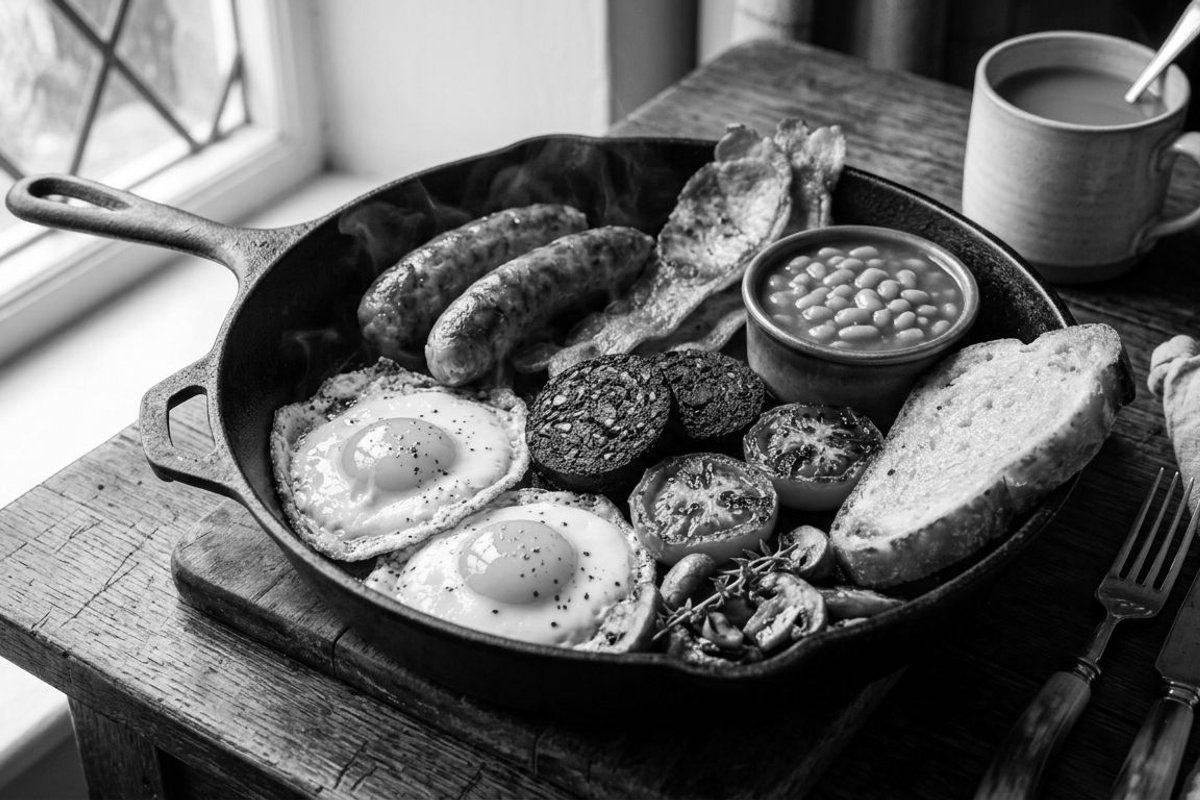
Quantities live in the recipe card.
The meats
The tray vegetables and potato
The pan components
Seasoning and fat
Doneness & Quality Checkpoints
- Tray 1: potatoes golden-crisp before tray 2 loads — the 25-minute head start is the schedule's foundation.
- Tray 2: all components within 5 minutes of done when the eggs begin; sausages at clear juices, bacon glassy.
- Eggs: basted shifts, never flipped, yolks intact through shift three.
- Six plates hot at once; trays to the table for seconds.
Big-Batch Full English for Six
Prep: 25 minutes · Cook: 55 minutes · Total: About 1 hour 20 minutes · Serves 6
Ingredients
The meats
- 12 pork sausages (960 g), pricked once each
- 12 rashers (600 g) smoked back bacon
- 12 thick slices (600 g) black pudding
The tray vegetables and potato
- 6 medium vine tomatoes (750 g), halved through the equator
- 450 g chestnut mushrooms, halved if large
- 3 red onions (450 g), cut into wedges
- 1 kg potatoes, par-boiled 8 minutes, cooled, cut into wedges
The pan components
- 12 large eggs (660 g)
- 60 g butter, plus more for the eggs in shifts
- 12 slices (600 g) thick white bread, for fried bread
- 600 g baked beans (1½ tins) or the homemade British-style baked beans
Seasoning and fat
- 45 ml / 42 g olive oil
- 5 g fine sea salt
- 2 g black pepper
- 2 tsp (4 g) brown sugar, for the tomatoes
- 10 g fresh thyme leaves
- 15 ml mushroom ketchup, for the beans (optional)
- Brown breakfast sauce and tomato ketchup, to serve
Instructions
- **Tray 1 — potatoes and onions, 25 minutes alone.** Preheat the oven and the empty trays. Toss the potato and onion wedges with half the oil, half the salt and pepper, and half the thyme on the hot tray 1. Roast 25 minutes, turning once at 15. Checkpoint — the wedges are deeply golden on their cut faces with crisp edges and fluffy centres, the onions charred at their tips and soft within, the tray carrying a film of golden fond — the base layer of the whole breakfast.
- **Tray 2 — everything else, plus 20 minutes.** As tray 1 passes 25 minutes, load tray 2: sausages at one end, bacon laid flat in the middle, black pudding and mushrooms tossed in the remaining oil at the other end, tomato halves cut-face up with the sugar, salt, and a drop of oil in the corner. Return both trays to the oven, tray 2 above tray 1, and roast 20 minutes more, turning the sausages and mushrooms once at 10. Checkpoint — the sausages are browned all over with taut skins and clear juices; the bacon lies flat, its fat glassy amber; the pudding is crusted and holding; the mushrooms are browned and glossed; the tomatoes have slumped jammy. Everything on both trays is within five minutes of done — which is to say, exactly on schedule.
- **The beans and the fried bread — the hob's long shift, 15 minutes.** While tray 2 cooks, warm the beans in a large pan with the mushroom ketchup at the barest simmer — 15 minutes thickens them to café consistency. In a second pan, fry the bread in batches in the butter, 90 seconds a side, holding the finished slices in the low oven on the warm plates' shelf. Checkpoint — the beans mound slowly on a spoon, darkened and savoury; the fried bread is golden and still bread-soft inside, all 12 slices warm in the holding oven.
- **The eggs — three shifts, 10 minutes, as the trays come out.** Pull both trays. Put the egg pan(s) over medium heat with a generous knob of butter. Fry 4 eggs at a time, basting to the butter-basted master's spec — 2–3 minutes per shift — sliding each shift onto the warm plates as it finishes. The trays' components hold their heat on their hot metal while the eggs run. Checkpoint — every egg across all 12: whites fully set, yolks liquid, edges laced gold. The shift rhythm is unbroken — the second shift's butter goes in as the first shift's plates leave the hob.
- **The landing — six plates, one moment.** Plates from the holding oven, each assembled in the café's order: beans contained to one side, egg at the crown, bacon and sausage flanking, pudding, mushroom, and a potato wedge or two at the sides, tomato and onion filling, fried bread propped. The trays go to the table on boards for seconds. Checkpoint — the table test: six plates, every component at eating temperature simultaneously, the last plate's yolk as runny as the first's. The big batch's single measure of success — synchrony.
Finish & Plate
Family style, with the trays on trivets down the table's middle and everyone serving or being served — the big batch's proper theatre. Sauces at both ends, a pot of builder's tea and one of coffee, and the plates assembled in the kitchen for the first pass. Boxing Day, birthday mornings, the morning after the wedding: this is the dish those days get remembered by.
Troubleshooting
| Symptom | Cause | Fix |
|---|---|---|
| Trays steamed, nothing browned | Crowded trays or a cool oven | Two genuinely large trays, preheated; 220 °C verified |
| Last plates' eggs overcooked | Shifts too slow, pan too hot | Medium heat, 3-minute shifts rehearsed; baste, never flip |
| Bacon pale from the oven | Tray crowded or pulled unpulled | 5-minute early pull plus the egg-pan flash for shatter |
| Potatoes raw-centred | Skipped the par-boil | 8 minutes boiling, cooled — non-negotiable at this volume |
| Cook frantic, plates late | No reverse clock | Write the T-minus map on paper before starting; the recipe is conducting |
Storage, Make-Ahead & Variations
- **Make-ahead:** par-boil the potatoes and mix the seasoning the night before; the beans improve made ahead entirely. Fully cooked components reheat from refrigerated on their trays at 180 °C for 12–15 minutes; the eggs alone are cooked fresh. - **Variation — the hash-batch hybrid:** skip the individual eggs and run the full-English hash master's wells-and-lid method across two oven pans — 8 eggs per pan, 6 minutes — for the calmest big batch of all. - **Variation — the mixed table:** two vegetarian plates built per the vegetarian master from the same trays' vegetables plus pan-seared haloumi run alongside the meats; one timing map, two diets. - **Scaling down:** the entire method is the oven-tray master with a second tray — the small batch and the big batch share one architecture, which is the point of the whole system.